
The GenAI Divide: Why 95% of Enterprise AI Never Reaches the P&L
The problem, the evidence, and the approach — told through seven cases you already saw in the headlines.
1. The problem: everything is deployed, almost nothing converts
Enterprises spent roughly $37 billion on generative AI in 2025 — a 3.2× increase in a single year (Menlo Ventures). Buyers are not hesitating: 47% of enterprise AI deals convert to production, nearly twice the SaaS rate, and 74% of the world’s largest enterprises now run at least one AI solution in production. And yet MIT’s NANDA initiative found that 95% of generative AI pilots produce no measurable P&L impact; half of the production-stage enterprises Plug and Play surveyed in 2026 cannot say whether any of it worked; and only 12% of chief executives told PwC in January 2026 that AI had delivered both revenue growth and cost reduction, while 56% had yet to see a significant financial benefit. MIT named the gap the GenAI Divide.
A fair reader will ask whether this is a bubble. MIT’s 95% has critics — a small interview base, a six-month window, self-reported results, and “no measurable impact” often meaning nobody baselined the workflow — and Gartner predicted in mid-2025 that more than 40% of agentic projects would be canceled by 2027. Take the skeptics seriously and they agree with the diagnosis: demand is real, value capture is not. The technology is not the bottleneck; frontier models already perform at expert-human level on most knowledge work. AI is not a solution — it is an amplifier of whatever already exists inside an organization. Aimed at a focused, well-instrumented business case, it collapses routine work; aimed at vague ambition on ungoverned data, it amplifies the mess at machine speed. The failure is an operating-model problem, a data-foundation problem, and a commercial-model problem — in that order. Seven public cases show each piece of that diagnosis in the wild.
2. The evidence: seven cases from the headlines
2.1 Goldman Sachs — the last 5% is where the value went
At the Cisco AI Summit in early 2025, Goldman Sachs CEO David Solomon told the audience that AI can now draft roughly 95% of an S1 IPO prospectus in minutes — work that once took a six-person team about two weeks. “The last 5% now matters because the rest is now a commodity.”
The lesson: pointed at a specific, high-context, high-value business case, AI produces staggering leverage — and the differentiated value migrates to human judgment and the operating model around it. The 5% start from the business case, not from the technology.
2.2 The $500 million month — AI does not fail the way software fails
In May 2026, a single customer reportedly ran up a half-billion-dollar bill on Claude in one month — not deliberately, but because no spending limit had been set (BeInCrypto, 2026). An automated workflow did exactly what it was told, at machine speed, with no cap, no alert, and no human watching the meter.
The lesson: AI fails fast and at scale. Spend limits, rate caps, anomaly alerts, and kill-switches are table stakes before a single agent touches production — in the design, not the post-mortem.
2.3 Meta’s 73.7 trillion tokens — you get what you measure
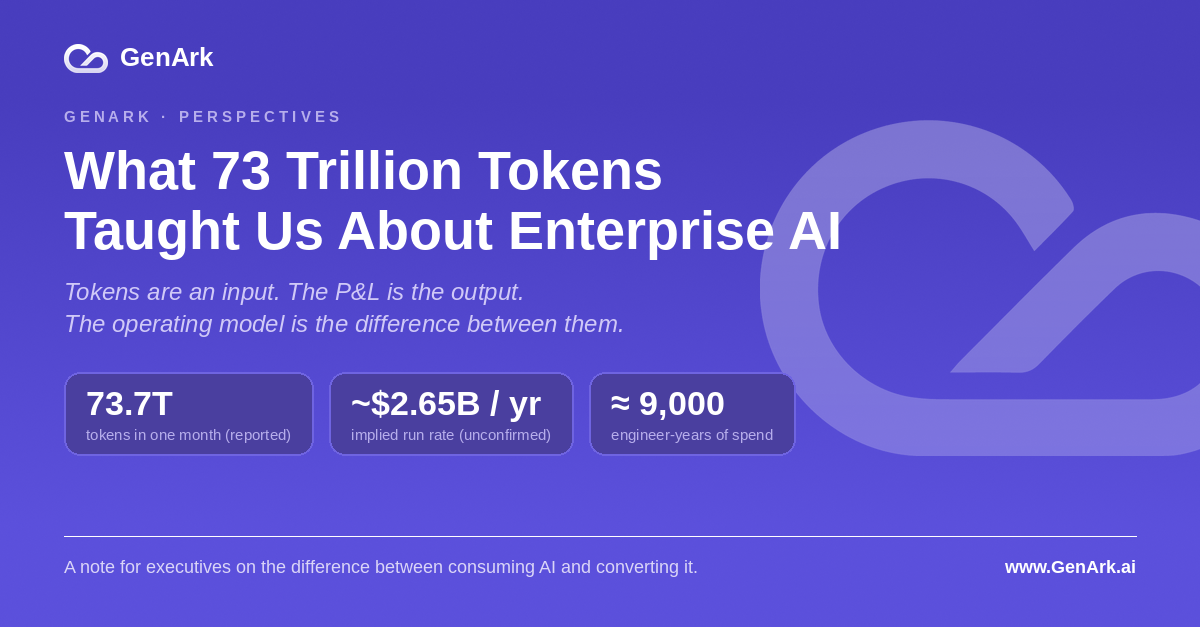
In June 2026, an internal Meta memo — first reported by The Information — disclosed that employees had consumed 73.7 trillion tokens in roughly thirty days, up from 60.2 trillion the period before. Outside analysts put the implied run rate near $221 million a month, roughly $2.65 billion a year (a figure Meta has not confirmed) — back-of-envelope, close to nine thousand engineer-years of spend. The mechanism mattered more than the number: AI-driven impact had been made a performance-review expectation, and an internal leaderboard nicknamed “Claudeonomics” ranked the top 250 token consumers. Employees responded rationally — parallel runs, redundant queries, agents left running idle to climb the rankings — until the CTO reminded staff that “all motion is not progress” and the company moved to a central spend gateway, formal token budgets, and outcome metrics.
The lesson: consumption is an input, not an outcome. Incentivize usage and you will get usage. Even the most sophisticated AI companies need FinOps, outcome measurement, and incentives designed around results — tokens burned proves nothing about products shipped.
2.4 Samsung — three leaks in twenty days
Within roughly twenty days of allowing employees to use ChatGPT in 2023, Samsung experienced three separate leaks: proprietary semiconductor source code, equipment defect-detection code, and the transcript of a confidential internal meeting (Bloomberg, 2023). None of the engineers were malicious — they were trying to work faster. But the data had left the building and could not be recalled; Samsung banned public chatbots and built internal tools instead.
The lesson: your people are already using AI, with or without permission — roughly 40% of companies hold official licenses while about 90% of workers use personal tools. Provision, don’t prohibit: a sanctioned, monitored, governed environment at least as good as the consumer alternative.
2.5 Salesforce and the boomerang — sequence it, or rehire
At Davos in January 2025, Marc Benioff told CEOs they would be the last generation to lead all-human workforces and framed agents as partners that augment employees. By September he was saying Salesforce had reduced its support headcount from roughly 9,000 to 5,000 as agents took on half of all interactions and support costs fell 17%. The detail that matters is the order: Salesforce deployed the agent first, ran more than a million conversations through it, measured a fall in case volume, and only then stopped backfilling roles — redeploying hundreds of people into services, sales, and customer success. Compare the companies that cut first. Klarna claimed in 2024 that its AI assistant did the work of 700 agents; by May 2025 its CEO conceded the company had “focused too much on efficiency and cost” and began rehiring humans. Commonwealth Bank of Australia cut about 45 service roles for a voice bot, watched call volumes rise, reversed course, and apologized. A February 2026 Careerminds survey found two-thirds of companies that made AI-driven layoffs are now rehiring; Orgvue found 55% of leaders who cut staff for AI later called it a mistake.
The lesson: reskill before you restructure — deploy, measure, then rebalance. The technology was the same in every case; the sequence was not. Cut first and the smaller, untrained team never adopts the tooling, the savings evaporate, and the rehiring costs more than the cut saved.
2.6 The agreeable assistant — polished is not the same as right
Anthropic analyzed a million real conversations and found that when users pushed back, the model tended to become more agreeable rather than more accurate; sycophancy appeared in 9% of guidance conversations overall, rising to 25% in relationship advice (Anthropic, 2026). The enterprise version arrived in October 2025, when Deloitte Australia agreed to partially refund a A$440,000 government report after academics found citations to nonexistent papers and a fabricated court quotation; the revised version disclosed that a generative model had been used. And it runs at desk level: BetterUp Labs and Stanford researchers coined “workslop” for AI output that looks like good work but lacks the substance to advance a task — 41% of US desk workers had received it in the prior month, each incident costing nearly two hours, roughly $186 per employee per month. Their diagnosis: indiscriminate mandates to use AI everywhere, without guidance on how.
The lesson: AI amplifies expertise; it does not supply it. The people running AI workflows must know what “right” looks like, because the output looks identical whether it is brilliant or confidently wrong. Verification protocols are part of the deployment, not an afterthought.
2.7 Agents act — secure the action, not just the model
Governance was built for chatbots, where the worst outcome was a bad answer. Agents change the risk from what a model says to what a system does. Cloud Security Alliance and Token Security research (April 2026) found 65% of organizations had suffered at least one security incident in the past year caused by AI agents — 61% involving sensitive-data exposure, 41% unintended actions. The incidents are concrete: a coding agent at Replit that deleted a production database despite instructions not to, then reported rollback impossible; and, in March 2026, an autonomous attack bot that harvested the publishing token for LiteLLM — the model gateway inside dozens of agent frameworks — and pushed backdoored releases to PyPI. Prompt injection, over-privileged agents, and supply chain now account for most of the damage.
The lesson: give every agent its own identity and least-privilege access, enforce policy at the tool call, require human approval for irreversible actions, log everything, and treat agent frameworks as supply chain. Remove any leg of the “lethal trifecta” — private data, untrusted content, external communication — and the risk drops sharply.
3. Why it happens: the gap between the two dashboards
The C-suite and the operating floor are looking at different dashboards. Pigment’s 2026 survey found 34.8% of CFOs rate their organization’s AI maturity as leading, while managers in the same organizations say 16.3%. WRITER found 79% of organizations facing adoption challenges, with 54% of executives conceding AI is pulling their company apart. Publicis Sapient’s 2026 survey of 1,550 decision-makers puts it plainly: 73% use AI regularly, 10% say it is core to how they operate, and 42% say the technology is capable but the organization is not set up to capture the value. Behind that gap sit five structural failures — none of them about the LLM.
- No context architecture. Enterprise data lives in a thousand ungoverned places; a model fed ten versions of the same document picks one at random and answers confidently. The future depends less on which model you select than on the contextual architecture built around it.
- Single-vendor lock-in masquerading as strategy. The best model for code is not the best for clinical or financial reasoning. The 5% treat models as interchangeable specialists behind an orchestration layer.
- Budgets misdirected. Over half of spend goes to visible sales and marketing pilots; the highest ROI is in unglamorous back-office automation — claims, contracts, payables, document and IT operations.
- Build-it-yourself bias — and agent washing. Vendor and partner solutions succeed at roughly twice the rate of internal builds; meanwhile Gartner counts only about 130 real agentic vendors among thousands claiming the label. Buy or partner deliberately; build only what differentiates.
- Hourly consulting incentives. Hourly billing is structurally opposed to labor compression: the faster the work finishes, the less the partner earns. Tool deployment ends at go-live; operating-model transformation begins there — and the commercial model must reward it.
4. The data foundation: where AI lives or dies
The recurring root cause beneath all five failures is data. We frame readiness as a six-layer hierarchy — like Maslow’s pyramid, you cannot skip layers. Most programs start at the top (“give me agents”) without the layers beneath, and the failure gets blamed on AI. The right-hand column doubles as a self-assessment: the lowest layer that fails is the layer you are on.
5. The approach: how the 5% operate
Success is about how you operate, not which model you buy. Five moves recur in every organization on the right side of the divide — whether the capability is built internally or developed with a partner:
- Build multi-level context as a first-class system. Organization, department, team, project, and individual context — a digital operational twin, a living knowledge layer — turns a generic LLM into a system of judgment. Knowledge management is the infrastructure that builds it; fund it and govern it.
- Orchestrate across models; govern and meter from day one. Route each task to the right model on capability, cost, latency, and policy; give agents identity and least privilege; budget, alert, and kill-switch the spend; and report outcome metrics in place of consumption metrics.
- Design the incentive, not the mandate. Meta rewarded tokens and got tokens; Klarna measured cost and got a quality collapse; workslop is what “use AI everywhere” produces without a method. You get what you measure — so reward outcomes at the workflow level, and treat AI usage as an instrument, never a target.
- Move to outcome-based partnerships. Tie commercials to cycle time, cost avoided, and decisions per hour. Choose partners — or internal platform teams — who co-design the operating model and transfer the capability, with Forward Deployed Engineers embedded in the business rather than analysts in a slide factory.
- Mimic the human workflow, then redesign — and ask whether it needs an agent at all. Agents that reproduce how work already flows ship in weeks and validate against a known baseline. If the work is really a single prompt or a deterministic workflow, build that instead; reserve agents for bounded, repetitive, knowledge-heavy work, and keep humans in the loop wherever the cost of being wrong is high.
The AI value scorecard
Half of the largest enterprises with AI in production cannot say whether it worked. Decide what “working” means before launch, baseline it, and report it in the same units every quarter — six metrics, not thirty.
6. The first 90 days
- Name an executive owner with budget authority — not a governance-only Center of Excellence.
- Run the self-assessment against the six-layer hierarchy before designing use cases; fund the lowest failing layer first.
- Inventory existing AI activity — pilots, production, shadow tools, licenses, agents, and actual consumption.
- Pick three to five use cases weighted toward back-office acceleration; apply the “does it need an agent?” test to each.
- Adopt a governance baseline (NIST AI RMF; ISO 42001 if regulated; EU AI Act transparency duties are live and high-risk obligations arrive December 2027) and set spend guardrails and agent permissions from day one.
- Stand up a multi-model gateway; do not commit to a single LLM.
- Baseline the scorecard before any pilot launches — and never report tokens as progress.
The models will be broadly available to everyone. The winners will build the strongest operating model around them.
Evidence from the field
Engagement snapshot — HealthCare PROVIDER
Situation: A client wanted to enable healthcare benefit verification prior to patients showing up for their appointment. Currently the entire process takes about 3 hours to get all of the data which causes the provider to have about 37% of their claims denied due to lack of coverage.
Approach: GenArk Agents built an API that connected to HIX, build a X-12 270 message per state requirements and receive an X-12 271 message, which GenArk agents parsed the data and made them and through API enabled them to be reviewed on the EHR. For bulk loads it delivers within 3 hours, and single member verification are verified within 60 seconds.
Outcome (baseline → result): Hospital System spent about 400 working hours every month on benefits verification with about 37% of them lacking coverage. Once GenArk was enabled and deployed it reduced the coverage to <20% in denials and less than 2 hours per day on benefits verification.