
You Didn't Buy a Technology. You Bought an Operating Model.
A note for executives on why AI budgets keep missing the P&L — and the one question that tells you whether yours will.
Two numbers from the same survey belong on the same slide. Eighty-one percent of senior technology leaders say they can deploy and govern AI at scale today. Seventy-five percent of the same group say their operating model has to change within eighteen months to keep going (Deloitte, June 2026). Two more, from a different survey: 80% of executives say AI has made them personally more productive. Thirty-seven percent say it has had any effect on their company’s profit — the same share as a year ago (McKinsey, August 2026).
Confident in the tool. Unready in the organization. Productive at the desk, invisible in the P&L. That is where most enterprise AI programs sit in 2026, and the reason is simpler than it looks. They bought the right thing in the wrong category.
What a technology purchase looks like
Most AI programs were bought the way companies buy software. A line inside the technology budget. Seats. An adoption target. A training module on how to use the tool. A dashboard that counts logins and hours saved. Run well, that plan delivers exactly what software purchases deliver: usage. It does not deliver a change in how the work gets done, because nothing in it was designed to.
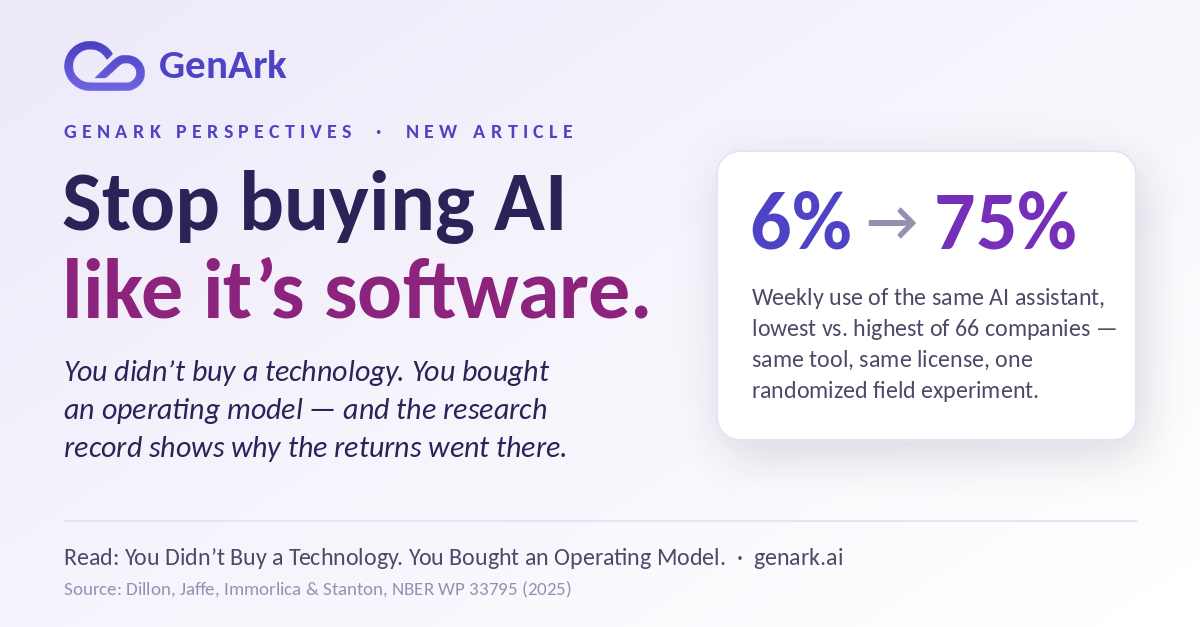
The evidence for this now comes from well beyond the consulting firms. When 66 large companies gave the same AI assistant to more than 7,000 knowledge workers under the same license, weekly use ranged from 6% of weeks at one company to 75% at another — and giving individuals the tool changed nobody’s mix of tasks (Dillon et al., 2025). When the Bank of England, the Atlanta Fed and the Bundesbank surveyed nearly 6,000 executives across four countries, 70% of firms said they use AI, more than 80% said it has had no effect on productivity or headcount in three years, and the executives who use it themselves average an hour and a half a week (Yotzov et al., 2026). Same technology, wildly different outcomes. Whatever explains that, it isn’t the technology.
The number that will not move
In 2020, MIT Sloan Management Review and BCG found that 10% of companies were getting significant financial benefit from AI. In August 2026, McKinsey put the share of companies attributing real money to AI at about 6%, unchanged from the year before. Between those two dates the technology improved by orders of magnitude, and corporate AI investment more than doubled in a single year. The share of companies turning it into profit did not budge. A bottleneck that ignores six years of progress in the technology is not a technology bottleneck.
Economists saw this coming, because they watched it happen with electricity. Factories put in electric motors and kept the old layout, and productivity sat still for decades until plants were redesigned around what the new power made possible. The tool arrived early. The operating model arrived later, and so did the returns.
What you actually bought
An operating model is the set of standing decisions about who decides what, how work flows, where the money comes from, what gets measured and rewarded, what the machines are allowed to do, and how all of that gets revised. The first item on an AI invoice is a technology. Every item after it has to be built and run, and none of it is for sale.
This summer Bain, Microsoft, IBM, Deloitte and McKinsey each published their version of the AI operating model within a few weeks of one another. They differ in vocabulary and agree on substance: a business owner accountable for the outcome; work rather than jobs as the unit of management, sorted into what agents do, what people do and what they do together; funding as a portfolio rather than a project; measurement in cycle time and cost per outcome rather than seats and tokens; an identity, least privilege and a human decision gate for every agent; and a quarterly rhythm for revisiting all of it.
Five signs you bought a technology
- The budget sits in IT. McKinsey still measures AI spend as a share of the ICT budget. The unit of measurement gives the assumption away.
- You count seats and hours saved. One in five employees reports no time saved at all (Gartner, 2026).
- A technology executive owns it. Seventy percent of chief data officers hold primary responsibility for the AI strategy and operating model (Gartner). Companies where senior business leadership shapes governance capture significantly more value (Deloitte).
- Training taught the tool. Education, not role or workflow redesign, was the most common way companies adjusted to AI (Deloitte, 2026).
- Measurement started after go-live. Companies capturing significant value are twice as likely to have defined how they measure impact — before the pilot, in the business’s own units (McKinsey).
What the six percent do instead
Nearly three-quarters of the companies capturing significant value have fundamentally redesigned workflows, against a quarter of everyone else. Their senior leaders are twice as likely to be visibly committed. They fund AI as a portfolio, govern agents from day one, treat the manager as the unit of adoption — employees whose manager actively supports AI are seven times as likely to say it helps them do their best work (Gallup) — and they revisit the operating model on a calendar, not at reorganization time. None of that requires buying anything new.
One question
Where does AI show up in our P&L, and who owns that line? If the answer is a technology executive and an adoption dashboard, you bought a technology. If it is a business leader and a cost-per-outcome number that was baselined before the pilot started, you built an operating model — and the technology you already own will start behaving differently.